Pravilo Guide editorial ·
History & Origins of Pravilo
What can we trace through documents, and how should we read the stories surrounding the practice?
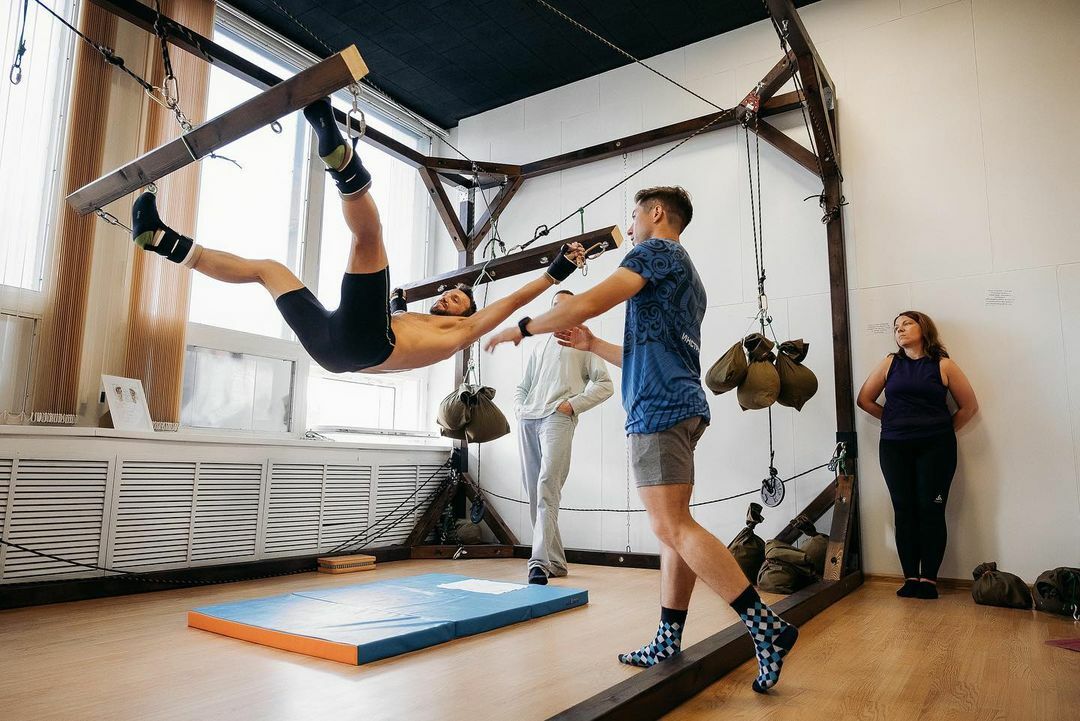
What is Pravilo?
Pravilo refers both to an apparatus with a frame, cables and cuffs and to guided practice using it. Equipment, teaching methods and session formats can differ between providers.
For practical questions before a visit, read: How to choose a Pravilo studio.
A practice with several origin stories
People often encounter Pravilo through a practitioner's account of its origins. These accounts can be an interesting part of a studio's identity, but a personal story, a literary narrative and a dated technical document answer different questions. This guide separates the modern apparatus's documentary record from claims of a much older lineage.
Pravilo usually refers to a frame and suspension system used in guided bodywork. A description of similar equipment does not, on its own, establish that every studio uses the same method or follows a single historical school. To explore today's practice, use our directory of studios and practitioners and check the details of the individual profile.
A documented reference point: 2007–2008
The Russian utility-model publication RU71256U1, titled “Training apparatus”, records a filing date of 11 October 2007 and a publication date of 10 March 2008. Its inventors are Sergey Aleksandrovich Zaytsev, Sergey Gennadyevich Kamensky, Vladimir Fyodorovich Ildyukhin and Andrey Sergeyevich Guzeev.
The document describes a frame, cables and cuffs. Application number 2007137762 and publication number RU71256U1 refer to different stages of that record. The patent text does not use the name “Pravilo”; a 2020 paper about Pravilo cites that application. The dates above come directly from the patent record, rather than the later paper's retelling.
This is a verifiable reference point for a particular modern design. It is not evidence that all stretching practices began in 2007, nor does it establish an uninterrupted ancient lineage for this apparatus.
Sergius of Radonezh and stories of ancient origins
Some contemporary origin stories associate Pravilo with Sergius of Radonezh. The historical name in Russian is преподобный Сергий Радонежский. Our review has not established a primary historical document connecting him to this particular apparatus. We therefore distinguish that association from the documented technical history.
The same distinction applies to accounts of ancient warriors training on Pravilo. Ask for the dated manuscript, image or archaeological record behind a claim, and check what the source actually describes. A modern illustration or a passage in a novel cannot establish that a specific device existed centuries earlier. An appealing story may be worth discussing as a story without being presented as verified history.
The absence of a verified source in this review is a limit of the evidence we can present. If a traceable primary document becomes available, it can be assessed and the article updated.
Origins and health outcomes are separate questions
The age of a practice and the existence of a patent do not establish what a session will do for an individual. Likewise, a study of stretching in general should not automatically be treated as a study of Pravilo. Questions about outcomes require evidence about the actual intervention, participants and measurements.
When comparing studios, discuss the equipment, the practitioner's training and the proposed session separately. Ask how the session is adapted, how communication works during it, and what information the instructor needs before a first visit. Our guide to choosing a Pravilo studio offers practical questions before booking.
Explore the practice today
Find a studio through Pravilo Guide, open its specific profile, then follow its official contact or booking channel. Confirm current arrangements directly with the studio. A directory listing is a starting point for a conversation, rather than proof of a historical or medical claim.
Sources and verification
- RU71256U1: Russian utility-model record — filing, publication, inventors and design.
- Ivanova, Pyanzina and Ermolaev, Human. Sport. Medicine, 2020;20(4):40–47, DOI 10.14529/hsm200404 — the later Pravilo paper citing the application.
- Holy Trinity–St Sergius Lavra library: Sergius of Radonezh — the historical name; not evidence of a Pravilo connection.
Sources checked on 9 November 2026. The Russian article was first published on 7 November 2026; this English edition was published on 9 November 2026.